
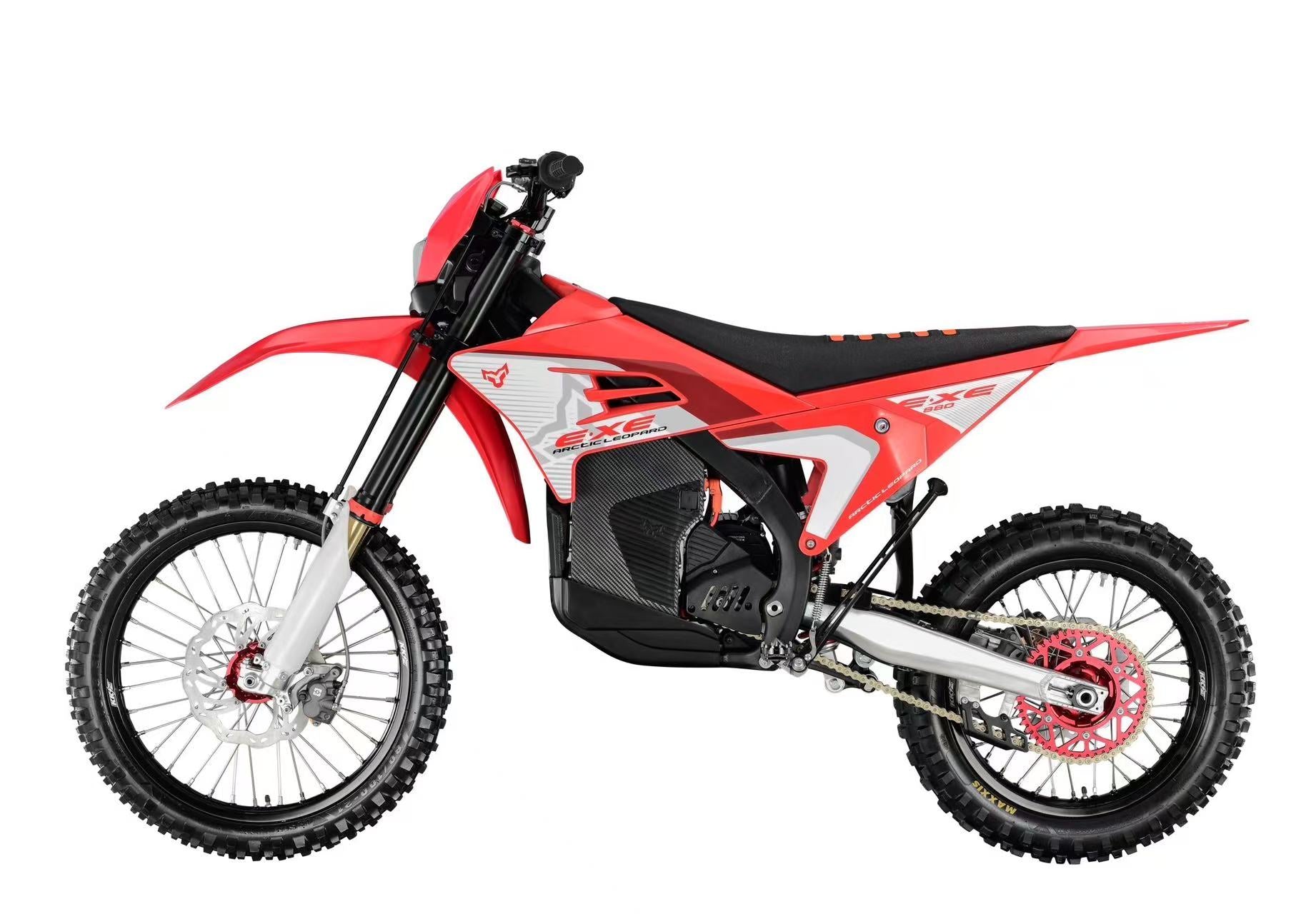

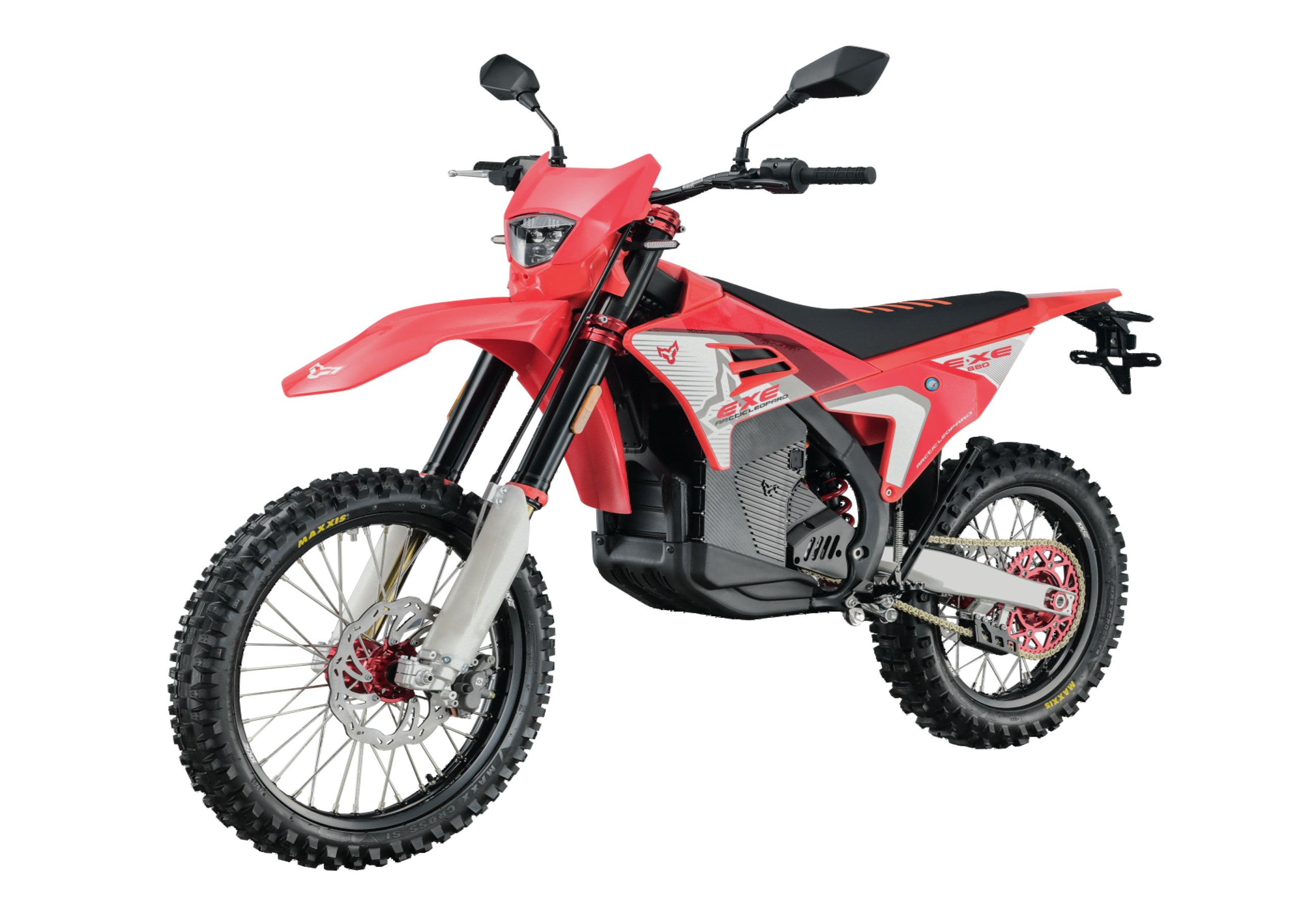
Arctic Leopard EXE 880 Enduro
Compatible Accessory
Technical Specifications
Descriptions
Electric Dirt Bike FAQs
Can electric dirt bikes handle water, mud, and pressure washing?
Most premium electric dirt bikes are built with an IP65 to IP67 weather-resistance rating, meaning they can easily handle rain, deep mud, and shallow water crossings—but they are not submarines.
Do I need a motorcycle license or insurance to ride an electric dirt bike?
If you only ride on private property or designated off-road OHV trails, you do not need a driver's license, registration, or insurance.
However, if you intend to ride your electric dirt bike on public streets and paved roads, the laws become a strict gray area:
Stock Condition:Out of the box, most electric dirt bikes lack turn signals, mirrors, horn, and a brake light license plate bracket, making themillegalfor street use.
The "E-Bike" Loophole Myth:Many riders buy aftermarket pedal kits to pass their bikes off as legal Class 3 e-bikes. Police departments worldwide are cracking down on this. If a bike can travel over 30 mph without pedaling, law enforcement treats it as a moped or motorcycle regardless of pedals.
Making it Street Legal:To legally ride on asphalt, you must buy a "Street Legal Kit" (lights, horn, mirrors), obtain a certificate of origin (MSO), and register the bike at your local DMV as a moped or highway-legal motorcycle, which will require a motorcycle endorsement on your license and liability insurance.
Can I ride an electric dirt bike on mountain bike trails or public OHV parks?
It depends on the bike’s classification and local laws, but generally, high-powered electric dirt bikes are banned from mountain bike (MTB) trails.In the US and Europe, standard e-bikes are restricted to Class 1, 2, or 3 (typically under 750W with a 20-28 mph limit). Most true electric dirt bikes (like the Sur-Ron Light Bee, Talaria Sting, or Stark Varg) output anywhere from 3,000W to over 10,000W and feature a pure twist throttle without pedals.
How long does an electric dirt bike battery actually last on a single charge?
While manufacturers love to advertise ideal ranges of 50–70 miles,real-world trail riding typically yields between 20 to 45 miles (or roughly 1.5 to 3 hours of continuous riding) on a single charge.Because electric bikes don't idle, battery consumption depends entirely on your riding style and environment. Here is what drastically changes your range:
The "Throttle Happy" Factor:Ripping open throttle in "Sport Mode" on sand, deep mud, or steep hill climbs can drain a standard 60V/38Ah battery in less than 45 minutes.
Technical Singletrack:If you are navigating tight, technical woods in "Eco Mode" where you maintain momentum at lower speeds, you can easily stretch the battery past 3 hours.
Pro-Tip for Trail Riding:Always calculate your ride bypercentage used per looprather than miles. If you've used 40% of your battery getting out, it’s time to turn back.
Electric vs. Gas Dirt Bikes: Is the maintenance really that much easier?
Yes, the reduction in maintenance is one of the biggest reasons riders are switching to electric.If you hate mixing gas, cleaning carburetors, adjusting valves, and changing oil filters after every few rides, electric is a game-changer.
If you have any questions, you are always welcome to contact us. We'll get back to you as soon as possible, within 24 hours on weekdays.
-
Shipping Information
Use this text to answer questions in as much detail as possible for your customers.
-
Customer Support
Use this text to answer questions in as much detail as possible for your customers.
-
FAQ’s
Use this text to answer questions in as much detail as possible for your customers.
-
Contact Us
Use this text to answer questions in as much detail as possible for your customers.